

The Present Moment, Part 4
“Eternity is in the present. Eternity is in the palm of the hand. Eternity is a seed of fire, whose sudden roots break barriers that keep my heart from being an abyss!” Thomas Merton[1]
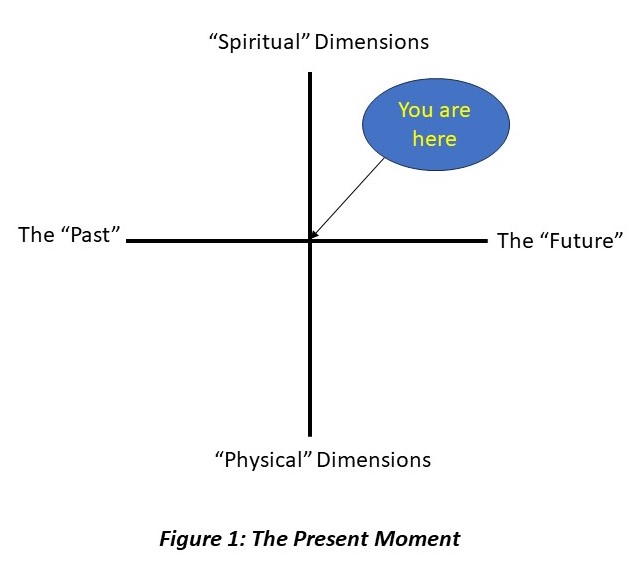
Figure 1 is the image I have been using to explore what the present moment is, what it means, and how we can better align our conscious awareness with it. The horizontal axis represents earth-time, as we conceive it, and extends infinitely in either direction. The vertical axis represents the state of our conscious awareness or attention. It also extends infinitely in either direction with points higher on the axis perceiving the spiritual, ethereal, intangible aspects of being, and points lower tending toward the material, denser, tangible aspects of being. The present moment is where the two axes meet. It is fluid because we are always moving along both axes.
The importance of having our attention consciously aligned with our location in earth-time is that our place of reality is there, the only place where we can co-create our lives. There is no power, control, or benefit in focusing our conscious awareness anywhere other than the present moment, except for purposes of wallowing in self-pity or losing ourselves in day-dreams.

Figure 3 illustrates our movement along the vertical axis, symbolizing the level or nature of our conscious attention. The world we live in can be perceived in various forms, from physical (material) expressions on lower points to non-physical (spiritual) energy at higher points. Using water as an example, at its higher, more energetic levels it manifests as steam. At its lower, more solid levels it manifests as ice. In between it manifests as liquid. Although it manifests differently at various points along the vertical continuum, it is still water. What we need from water determines which of its forms (where on the vertical axis) we attempt to engage.
Our conscious attention can move up and down in such a way that we can engage with the objects, events, and relationships we experience in earth-time in their more spiritual (energetic) or more material (solid) natures, depending on what is needed in the moment. As an example, assume I am in a relationship where the other person treats me poorly. At the lower, more material points on the vertical axis of conscious attention, this person clearly acts in ways that are disrespectful and rude. That is a solid, tangible reality. If I seek a less-tangible, more spiritual view of the relationship by assessing it from a higher, more malleable level of conscious attention it may become obvious that this person treats me poorly because I reflect something to them that they cannot accept or acknowledge in themself. The latter view allows for a deeper understanding of where conscious attention is needed that might heal the relationship. I will never arrive at that understanding, however, until I raise the level of my conscious awareness to a higher, less-inflexible level. When the appropriate level of my conscious attention intersects with my current experience in earth-time, I enter a state where I can positively impact negative aspects of my life. If my conscious attention is anywhere else on either axis, I am powerless and will feel victimized by my circumstances.
Although it is seldom as easily perceived as with water, everything in our world exists in various forms, from its spiritual, energetic, non-physical essence to its material, inflexible, solid nature. We often experience objects, events, and relationships in only a single state of manifestation because we lack the knowledge of our freedom to perceive in alternative ways that allow for new insights and different understandings. That alternative viewing is represented as moving our attention up or down the vertical axis in Figure 3. In order to recognize and process certain experiences we need to interact with them in their more solid, tangible states. In order to more deeply understand and resolve other experiences we need a bigger picture, a less solid view that is only available from a higher-level, less-concrete view. Changing where and how we experience something on the vertical axis of our conscious attention does not change the object, event, or relationship, but it does change how we interact with and are impacted by that object, event, or relationship. And that is the beauty and magic of consciously attending to the present moment in time from various levels of awareness.
This is the 12th in a series of Life Notes on Space, Time, and Eternity. The opinions expressed here are mine. To engage with me or to explore contemplative spiritual direction, contact me at ghildenbrand@sunflower.com.
[1] Thomas Merton, The Sign of Jonas, Harcourt Inc., 1953, p. 361.
Discover more from Contemplating Grace
Subscribe to get the latest posts sent to your email.
 Contemplating Grace
Hi Greg – I’m really enjoying The Present Moment series. Today’s water analogy on the vertical access was extremely helpful. Thank you for ministering to the world. Alicia (FOP-friend of Pam).
LikeLike